


Current Team Projects
Technology and Transitions (TNT)
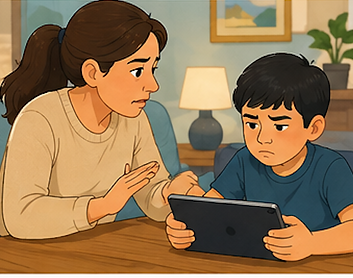
This project examines how children’s digital media use relates to real-time behavior, emotional responses, and longer-term functioning. The study centers on transitions when children are asked to stop a preferred digital activity and shift to a less-preferred non-digital task. The study combines multiple types of data, including caregiver ecological momentary assessment (EMA), audio recordings, wearable physiological data, behavioral observation, and follow-up measures over time. The project aims to clarify how digital media use and transition difficulties relate to irritability, attention, academic functioning, and broader development. This study is funded by a Special Projects Grant from the Huo Family Foundation and a Collaborative Data Science Grant from the Frost Institute for Data Science and Computing (IDSC). The study is expected to begin recruiting in Summer/Fall 2026, and both local and remote participation options are available for eligible families.
Understanding the Real-world Drivers of Irritability Via Engagement (U-DRIVE)
This project uses a community-engaged national online survey to identify common frustration triggers in the everyday lives of children and adolescents and clarify how these experiences relate to mental health outcomes. Caregivers complete parent-report symptom measures and describe common situations that frustrate their children. By applying machine learning methods to these data, the study aims to identify patterns of frustration triggers and examine how they relate to youth mental health symptoms. This project is supported by the Miami Clinical and Translational Science Institute, Grant UM1TR004556 from the National Center for Advancing Translational Sciences.

The Child, Family, and Community Research Network (CFCRN)

The Child, Family, and Community Research Network (CFCRN; https://www.cfcrn.org/) is a voluntary research registry and resource network for caregivers of children and adolescents. Through a brief online registration survey, caregivers can choose to be contacted about future research opportunities for which they or their children may be eligible. The registry itself does not enroll families into specific studies; instead, it helps build a secure, community-based pool of families interested in learning about research aimed at understanding and supporting child and family wellbeing. By emphasizing broad community recruitment, CFCRN aims to improve the diversity, inclusiveness, and efficiency of child and family research. This project was launched with support from a Provost’s Research Award.
Community Survey Projects
We have collected a range of online survey samples to study psychological assessment and social, emotional, and behavioral functioning in a variety of populations. This work helps clarify how behavioral and emotional difficulties present across diverse groups while also strengthening recruitment, measurement, and assessment methods. The University of Miami Child and Adolescent Needs Survey examined concerns among children ages 6 to 14 in the Miami community and evaluated different online recruitment strategies. The Forms and Functions of Behavior Study examined aggression and related emotional and behavioral factors in children and adolescents across North America, while also informing the assessment of youth aggressive behavior in English- and Spanish-speaking samples. Ongoing subject pool studies extend this work to emerging adult college student participants in psychology research.

Graduate Student Projects
The Frustrating AX-Continuous Performance Task Study (FAX-CPT)

This project, led by graduate student Shannon Shaughnessy, examines how frustration affects cognitive control and decision-making. A central focus is the development and validation of a new frustration induction paradigm, the Frustrating AX-Continuous Performance Task (FAX-CPT), designed to test how frustrative nonreward influences the balance between proactive and reactive control strategies in young adults. The study also examines how individual differences in irritability and frustration relate to changes in cognitive control and goal-directed behavior. By identifying mechanisms through which negative emotional states disrupt self-regulation, this work aims to deepen understanding of irritability and emotional dysregulation and inform future intervention targets. This project is funded by the National Science Foundation Graduate Research Fellowship Program and an American Psychological Foundation Council of Graduate Departments of Psychology Graduate Research Scholarship.
Family Profiles and Service Seeking
This project, led by graduate student Ashley Karlovich for her dissertation, examines how child, parent, and family factors shape youth mental health service-seeking. Using a person-centered approach, the study aims to identify distinct family profiles based on behavioral and emotional characteristics and test how these profiles relate to past help-seeking, current attitudes toward care, and intentions to seek services in the future. By clarifying which family patterns are linked to barriers or openness to treatment, the project aims to inform more effective outreach and more tailored support for families seeking mental health care. This project was supported by the South Florida P.E.O. Jean Anderson Fund Scholarship Award and a Flipse Funds Award.

Previous Projects and Lines of Work
Real-Time Understanding of Mood and Behavior in Everyday Life (RUMBEL)

This study examined whether caregiver-reported ecological momentary assessment (EMA) can effectively capture children’s mood and behavior in real-world daily life. Over a 30-day period, caregivers used a smartphone app to complete brief surveys multiple times per day, report on outbursts as they occurred, and provide biweekly summaries of their child’s mood and behavior over time. By combining repeated real-time reports with broader check-ins, the study aimed to clarify factors associated with irritability in everyday contexts and evaluate EMA as a practical tool for measuring mood and behavior outside the clinic. This project was funded by the John and Polly Sparks Early Career Grant for Psychologists Investigating Serious Emotional Disturbance from the American Psychological Foundation (APF).
Longitudinal School Research
This line of research is based on a long-term collaboration with Paula Fite (University of Kansas) and a partnership with a local public school district. The research team collected teacher-report surveys, child self-report surveys, and school records on a large sample of elementary school children in grades K-5 over several years of repeated data collection. These longitudinal, school-based data have led to numerous research papers examining questions related to youth mental health, social-emotional development, and school functioning across childhood. These data continue to provide a rich foundation for research on psychopathology risk processes and children’s developmental outcomes in the school context. This work was supported by APF (Elizabeth Munsterberg Koppitz Child Psychology Graduate Fellowship) and the University of Kansas (Lillian Jacobey Baur Early Childhood Fellowship, Doctoral Student Research Fund, Pioneers Classes Dissertation Research Award).

WHO/ICD-11 Research

For more than 10 years, Dr. Evans contributed to research supporting the development and evaluation of the World Health Organization’s International Classification of Diseases (ICD-11) Mental, Behavioral, and Neurodevelopmental Disorders. With collaborators including Geoff Reed, Michael Roberts, Jared Keeley, John Lochman, and Jeff Burke, this work focused on irritability, disruptive behavior, and field studies designed to inform diagnostically useful revisions for global mental health practice. Across integrative reviews, global clinician surveys, formative studies, and international field trials, this research helped guide the conceptual development of ICD-11 and shaped how disruptive behavior and irritability are formulated in youth mental health research and clinical settings around the world.